
Showing posts with label posted by Annalee. Show all posts
Showing posts with label posted by Annalee. Show all posts
Tuesday, April 22, 2014
Hello to Youtube and Goodbye to this Blog

Wednesday, April 16, 2014
Down the Rabbit Hole of Writing: A Survivor's Tale
 It’s hard to exactly pinpoint when the idea for this final
paper really began. In some ways, it’s been building throughout this entire
semester, becoming refined in each of the smaller papers we have written on Alice in Wonderland. From talking with
Professor Burton in the paper conferences we've had after each one, I did start
this paper with the intent of talking about existential meaning in some way.
But I think the real beginning came as I went back to one of my favorite books,
The Count of Monte Cristo and wrote about why I love it so much. I think a lot of times, being English majors, we forget
this important detail as we get so focused in getting an essay done—that we
love books. In this whole process, the only thing that kept me from despairing
over my attempt to compare Alice in Wonderland to The Count of Monte Cristo was
the constant reminder of why I love the book: because of its fascinating
ending.
It’s hard to exactly pinpoint when the idea for this final
paper really began. In some ways, it’s been building throughout this entire
semester, becoming refined in each of the smaller papers we have written on Alice in Wonderland. From talking with
Professor Burton in the paper conferences we've had after each one, I did start
this paper with the intent of talking about existential meaning in some way.
But I think the real beginning came as I went back to one of my favorite books,
The Count of Monte Cristo and wrote about why I love it so much. I think a lot of times, being English majors, we forget
this important detail as we get so focused in getting an essay done—that we
love books. In this whole process, the only thing that kept me from despairing
over my attempt to compare Alice in Wonderland to The Count of Monte Cristo was
the constant reminder of why I love the book: because of its fascinating
ending. Thursday, April 3, 2014
Battling Reluctance
So yesterday, while I was more excited than usual to write some more substance into my paper, I still delayed as much as possible in working on it. I used all sorts of things to postpone actually writing sentences. I don't know why I find it so hard to begin writing. But once I did, I was able to get a whole page down (woo! 3-4 more to go today!) so that's decent progress for me. From the ridiculous battle against my reluctance to write, I did manage to find one tactic that did helped me just get going: doing a 5 minute free write completely disconnected with my paper. So as I head into today, I'm going to do another free write, and then just get going. If I need some sources to back me up, I'll be in the library so I can easily access that as I go. But what works for y'all in getting yourself to finally write?
Monday, March 31, 2014
Tally-Ho! A Writing We Will Go
What's next? As we are heading into the end of this week where we have to produce 4-5 more pages of our draft, I am feeling okay. Normally I would be panicking and avoiding my paper, but its really helped that we have done little bits of preparation for this paper these past couple weeks. I really like my thesis right now, and while I'm sure it will get tweaked, I feel very good about what I am going to be writing. What I need to to this week, is to spend some more time with my sources, and really pick out quotes and evidence to use in my paper. Tori encouraged me to use the Chat with a Librarian thing to find the French Encyclopedia in English that I so desperately want, so I'm definitely going to do that this week. And then I just need to write! And, dare I say it, I'm actually looking forward to writing.
What the Harry Potter Symposium Taught Me
Let me tell you a sad story. Once upon a time, I was shadowing an 8th English class and we were all in a library. The librarian asked the students to raise their hands if they have read the Harry Potter books. About 3-5 out of twenty students raised their hands in each of the 4 classes I attended. That's like 20% people. After that experience, I decided that if I became a middle school teacher or even got to do British literature in High School, I would most definitely be bringing Harry Potter to the masses! So I was incredibly excited to go to the Harry Potter Pedagogy (or teaching) Symposium.

While none of the content related to The Count of Monte Cristo or my thesis whatsoever, two of the the three presented their comparison papers. Which is what I'm most nervous about in writing my paper-its comparison structure. It was helpful to see their successful structure. One person compared Remus Lupin's teaching style to Dorlores Umbridge's, while another compared the first day lesson plans of Lupin, Umbridge and Treawley. Both of them organized their presentation by focusing on each character at a time. I realized that for my paper, if I did that tactic, I could easily end up giving more importance to Edmond Dantes, who I have a lot more text on, and make the comparison unequal between him and the Queen of Hearts. So I am going to organize my paper based by the common and contrasting elements not the characters.
Tuesday, March 25, 2014
The Game is On!
My research day was productive, but also frustrating. I am earnestly looking for a Count of Monte Cristo Concordance and a good Encyclopedia about France in English not French. While I am still on the hunt for these, I did find a couple other texts that do talk about the religious and social atmosphere in the 19th century in France, which is wonderful. Anyways, so here is my working thesis (I’m still wondering if I have too much going on):
 |
| Creative Commons License 2.0/Super Furry Librarian |
In the 19th century, scientific discoveries and new social constructs caused a surge of existential confusion. It led to doubts and questions about the power of an individual in relation to society and God. These questions echo in Alexandre Dumas’ The Count of Monte Cristo and in Carroll’s Alice’s Adventures in Wonderland in their similar battle for individual control and meaning over society and God. Edmond Dantes claims to be acting in the stead of Providence throughout much of his journey in The Count of Monte Cristo, but his tirade of vengeance and refusal to connect with society result in the gradual displacement of God, and the substitution of himself in the role of justice. Similarly, the Queen of Hearts displaces Alice, the dreamer of Wonderland, as an authority figure and also distances herself to rule over society. Ultimately, the restoration of the rightful ruling power in both texts presents the futility of man in creating their own existential meaning independent of an established outside center.
Friday, March 21, 2014
Feels like a Tug of War
Digging into my paper has showed me how much more I need to research and has also helped me figure out what information I am looking for. So that's been great as now I don't feel like this paper is a giant, terrifying monster. Anyways, so while I decided to let go of comparing Edmond Dantes and Alice (her character) and to instead compare him with The Queen of Hearts, I still haven't let go of my interest in existential meaning in the 19th century. I'm worried that perhaps I have too much going on in my paper. Also, I feel like my comparison is starting out to be a tug of war rather than flowing. So thoughts? Any advise on how to do a successful compare/contrast paper?

Here the link to it, so check it out: Edmond Dantes and the Queen
Good Success on Goodreads
So this week I posted several comments and questions on reviews on goodreads, and actually got a response back! It made me realize that if I choose to talk about the extent of God/Providence in Edmond Dantes life, researching a little more carefully into Alexandre Dumas’s religious background would be a good idea. Also, she brought up free will, which has come up repeatedly in my conversations with people about my idea and in just talking about Count of Monte Cristo. So I am thinking of considering that as a potential point to talk about in my paper.

I have never heard about BYU’s ScholarsAchive until this week, and have decided that submitting my paper to it seems like a low-risk, low-stress option.
I also looked into the BYU’s English Symposium, and I really like how it covers a vast area of literary space, and I am super interested in submitting something to it next year.
Sophi mentioned the blog, Interesting Literature and I checked it out and read some of their articles. I really like the style that they have and their topics. I noticed that a lot of their Guest Blogs are in list form, and I think it could be a cool way to adapt a paper to blogger-friendly.
Publishing Avenues:
The idea of publishing my paper makes me more excited about writing it (which honestly, I need all the excitement I can get as we near the end of the semester) and a little more nervous about doing a good job on it.I have never heard about BYU’s ScholarsAchive until this week, and have decided that submitting my paper to it seems like a low-risk, low-stress option.
I also looked into the BYU’s English Symposium, and I really like how it covers a vast area of literary space, and I am super interested in submitting something to it next year.
Sophi mentioned the blog, Interesting Literature and I checked it out and read some of their articles. I really like the style that they have and their topics. I noticed that a lot of their Guest Blogs are in list form, and I think it could be a cool way to adapt a paper to blogger-friendly.
Monday, March 17, 2014
A {working} Thesis is Born!
 |
| My Mind Map |
Friday, March 14, 2014
Edmond Dantes: Playdough or no?
Within the first chapter of the book, Edmond Dantes has everything taken from him—his career, his fiancé, his father, his good name. However, through his time in the prison and with Abbe Faria, he learns so much more about the world, and also gains the knowledge of a vast fortune, more than anything he could have amassed as a Captain of a ship. Miraculously, he escapes, and then begins his violent and ingenious crusade of vengeance. This will to avenge becomes the sole motivator of his life. By the time he returns to France, the narrator of the book no longer refers to him as Dantes. The narrator refers to him as “the Count” or sometimes even just “the man,” and describes him no longer as a humble, earnest person, but a “Avenging Angel,” who holds “deep in his heart a roar which would have made (people) flee in terror to hear it.”
Dantes clings to the idea that if you “examine (his) past and present, and try to guess the future” you can decide whether or not God shaped him into one of his “instruments.” So here’s my question, do you think Edmond Dantes’ story proves that he was made to be an “instrument of God,” and if so, do his actions accurately reflect that?
 |
| Creative Common 2.0/ Jake Gamage |
In addition to this blog, I’m planning on asking this question to some of my coworkers who’ve read Count of Monte Cristo, some of my past English classmates, and also reviewers on goodreads.
The Consequences of Wielding Providence
So I’ve let myself pause and re-evaluate where I’m really going to go with the Count of Monte Cristo these past couple days. The major aspect of the book, that I wrote about before which draws me into it, is the question of whether Edmond Dantes will really find happiness and peace after all the horrible and fantastic things he’s done. His drive to act for Providence gradually evolves for substituting himself in the place of Providence. I think I want to dig into his need to control and manipulate life, the resulting displacement of God and the consequences of that. I think I could even connect it to Alice (Hurrah!) and her desperate attempts for control over her Wonderlands.
 |
| Creative Commons 2.0/ Tony Delgrosso |
Key Passages:
“Each time he pressed down with his foot, a jet of blood spurted from the man’s throat. Franz started backward and sank half-fainting into a chair. Albert remained standing, but his eyes were closed and he clung tightly to the window curtain. The count was as erect and triumphant as the avenging angel” (Dumas 143).
“ ‘I have always heard of Providence yet I have never seen it or anything resembling it, which makes me think it does not exist. I want to be Providence, for the greatest, the most beautiful and the most sublime thing in the world is to reward and punish’. But Satan bowed his head and sighed. ‘You’re mistaken he said, ‘providence does exist, but it is invisible; you have never seen anything resembling it because it works by secret springs and moves in hidden ways. All I can do for you is to make you one of the agents of Providence.’ I made the bargain with him; I may lose my soul because of it,” (213).
Tuesday, March 11, 2014
Heigh-Ho, Heigh-Ho, to the drawing board I go
.jpg) |
| From Wikipedia |
.jpg)
Posting my thesis both on the blog, on Facebook, and
talking about it with my roommates forced me to confront the scary idea I'd been avoiding: that my initial idea may not work, and doesn't really make
me excited to write it. In a past paper, I talked about how Alice wasn't mad,
but found a way to cope with the madness by creating her own meaning. I really liked my last paper and wanted to
execute it better and continue with this idea with the Count of Monte Cristo.
But things are not exactly flowing together. Tori called it out best on the blog. She
pointed out that there seemed like there was too much going on in my thesis and that the comparison format made it look like two papers instead of one. On
Facebook, one of my past high school teachers commented and made me realize
that my set up inadvertently led to the conclusion that one way to find existential
meaning was better than the other—which isn’t really where I wanted to go. So
right now, I’ve decided to focus on Count of Monte Cristo first, and get an
idea of what I want to do with it and then connect it to Alice. What forever interests me is the ending scene. Edmond renounces his attempts to play God and then desperately hopes to find himself through others. This moment contradicts everything he worked for—all his talk of being no one, all his vicious plots for revenge. I think I'd like to do something with this idea of futility.
Friday, March 7, 2014
Needing a little more Oomf
This is my thesis that I am working on. Right now its a comparison thesis, but I'm thinking of making it more of a policy, because I think I am missing the so-what punch to it:
During the 19th Century, both England and France
suffered a loss of stability. This instability sparked a thirst for existential
meaning in both societies. For France, confusion arose from their political and
social disruptions; in England, it was due to the ideological battles between
religion and science. In contrast to Lewis Carroll’s Alice in Wonderland stories which promote self-creation of meaning,
Alexander Dumas’s The Count of Monte
Cristo stresses that personal meaning is only found through others and
ultimately God.
I'm going to post a shortened version of this on my Facebook.
Everyone Needs a Shopping Buddy
 |
| The Ugliest Blouse in the World |
Last year I went shopping with my roommates at Kohls. We all
got separated in the store, going to different sections that caught our
interest. I ended up wandering in the more professional section, looking for
something different from my usual style, and oh boy did I find it: A sea foam
green, lacy blouse. And I thought it was
super cute. I tried it on in the dressing room, and while its cut seemed a
little strange to me, I felt that I could pull it off. Stupidly, I bought it,
without finding another opinion. Y’all,
the truth is, the blouse was the ugliest thing in the world. It had the
incredible power of making everyone who dared to wear it look shapeless and
box-like. Once I modeled it for my darling roomies, they quickly told me how
awful it was.
Everyone needs a good shopping buddy, someone to tell you
their honest opinion of your ideas and to prevent you from spending time on
something doomed from the start. I’m blessed to have several such people in my
life:
Tuesday, March 4, 2014
Listening to Abbe Faria
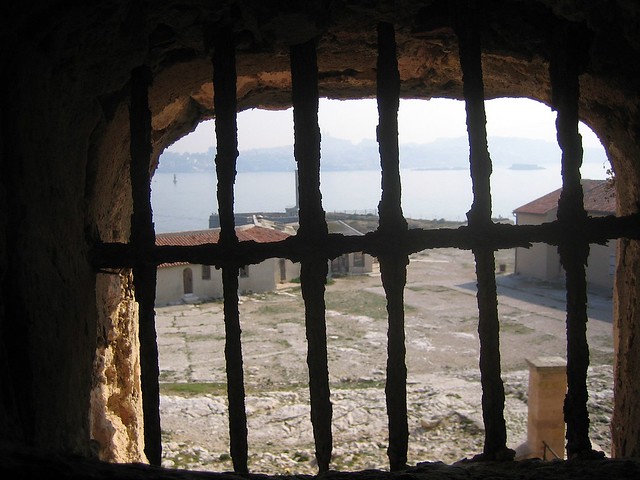
I first read The Count of Monte Cristo in middle school. I was book-hungry, hunting around my house for something new, and came across a yellowed, worn copy of it. After reading the back, I thought, “Cool. I love Batman, this will be perfect.” I just wanted something breezy to get swept up in, something to take me to a completely different world. I was not expecting it to have any depths beyond the typical jaded hero story. Then Abbe Faria broke into Dante’s miserable, hopeless cell.
“You’re my son!’ cried the old man. ‘You’re the child of my captivity. My profession condemned me to celibacy, but God sent you to console both the man who could not be a father and the prisoner who could not be free,” (Dumas 72).
 |
| Creative Commons License 2.0/Dusty Dean |
Suddenly, the oath of vengeance Dantes made, his horrible dark circumstances, all took a back seat to this moment: this tender expression of love and its identifying power. I was 13 and belonging—to someone, to myself, to a situation—was something I desperately wished for. The book became real to me.
Subscribe to:
Posts (Atom)