I've started to do some research about the general topic of my thesis--language in relation to thought. Professor Burton pointed out the Sapir-Whorf hypothesis to me in a comment on a post from a little while ago, so I decided to do a bit of additional research on the theory itself. I found a few articles about the theory and its relevance today, as well as, to some extent, its use in literature, so I think that will be really helpful.

Showing posts with label Annotated Bibliography. Show all posts
Showing posts with label Annotated Bibliography. Show all posts
Wednesday, March 26, 2014

Perks of Finding New Sources
Each time I go to the library, I spend more time in there than I originally planned. There are so many options to choose from and it takes a while for me to narrow down my choices. I'd also like to thanks the wonderful librarians who have helped me along the way. Without them, I would still be pretty lost. Searching for more sources can be difficult but that's how you know you're getting somewhere. Trying out different ones to see if they work or not is part of the process. Familiarizing myself with the library has also helped me tremendously in my researching. The more I visit, the better I get at this!
Here's my updated thesis statement: (still want to change it a bit...)
The concepts incorporated in the novel The Perks of Being a Wallflower are equally expressed in the film adaptation which was directed by the author Stephen Chbosky, making the film and novel necessary to each other for the complete experience of the story.
When You Give a Girl a Library...
 |
| Public Domain CCO / Pixabay |
At any rate, here is a new and improved list of sources:
THESIS: Just as Alice is ridiculously scorned, mislead, and reprimanded by the authority figures in her journey through Wonderland, the offspring of Addie Bundren represent the precarious condition of children that do not have reliable authority figures in their lives in the novel As I Lay Dying. Lewis Carroll and William Faulkner's works identify the damage caused to children by dysfunctional family environments and autocratic adults.
Tuesday, March 25, 2014
Sources are the hardest thing for me to choose
Well, I said it. I actually enjoy writing papers and I enjoy using sources to establish a paper. However, I have a very passionate dislike for finding the sources. I like sending the time searching for a source, but I hate feeling let down when a source isn't what I originally thought or if a source that I desperately need is unavailable in one form or another. That being said, here is my working annotated bibliography.
Now We're Getting Somewhere
I spent a lot of time wrestling with my thesis statement over the weekend. I tried to organize it so that it would be clear and helpful for forming my paper. I got some great feedback from my peers and enthusiasts that helped me redirect my thoughts toward the main idea that I wanted to present. My new thesis is this:
Ernest Hemingway wrote The Sun Also Rises during a time when many people felt confused about commonly held notions about society and human nature. The Great War, in all its rugged and harsh brutality, had altered the perception that humans were naturally good and noble creatures. Many people struggled to find meaning and identity during these years and became part of a Lost Generation in the process. Although Ernest Hemingway suggested otherwise, the characters from The Sun Also Rises become part of the Lost Generation as they habitually run from their painful reality that was caused by the traumatic Great War.
Ernest Hemingway wrote The Sun Also Rises during a time when many people felt confused about commonly held notions about society and human nature. The Great War, in all its rugged and harsh brutality, had altered the perception that humans were naturally good and noble creatures. Many people struggled to find meaning and identity during these years and became part of a Lost Generation in the process. Although Ernest Hemingway suggested otherwise, the characters from The Sun Also Rises become part of the Lost Generation as they habitually run from their painful reality that was caused by the traumatic Great War.
Snow White and the Seven New Sources
 |
| hakirah.org |
Here's an updated thesis:
The novels Ella Enchanted and Fairest are both fairy tale adaptations written by Gail Carson Levine. The young female protagonists, Ella and Aza, teach opposite lessons than the fairy tales they are retelling, redefining a woman’s beauty, success, and happiness as a result of hard work, wit, and determination rather than the effect of external actions, people, and circumstances.
The Game is On!
My research day was productive, but also frustrating. I am earnestly looking for a Count of Monte Cristo Concordance and a good Encyclopedia about France in English not French. While I am still on the hunt for these, I did find a couple other texts that do talk about the religious and social atmosphere in the 19th century in France, which is wonderful. Anyways, so here is my working thesis (I’m still wondering if I have too much going on):
 |
| Creative Commons License 2.0/Super Furry Librarian |
In the 19th century, scientific discoveries and new social constructs caused a surge of existential confusion. It led to doubts and questions about the power of an individual in relation to society and God. These questions echo in Alexandre Dumas’ The Count of Monte Cristo and in Carroll’s Alice’s Adventures in Wonderland in their similar battle for individual control and meaning over society and God. Edmond Dantes claims to be acting in the stead of Providence throughout much of his journey in The Count of Monte Cristo, but his tirade of vengeance and refusal to connect with society result in the gradual displacement of God, and the substitution of himself in the role of justice. Similarly, the Queen of Hearts displaces Alice, the dreamer of Wonderland, as an authority figure and also distances herself to rule over society. Ultimately, the restoration of the rightful ruling power in both texts presents the futility of man in creating their own existential meaning independent of an established outside center.
Monday, March 24, 2014
The Revelation in Research
So while I was researching my topic, I stumbled upon a review articles entitled, "Death, Resurrection, and Fall in Dumas' Comte de Monte-Cristo." I began researching Christ figures in The Count of Monte Cristo, hoping to find something to tie in with Abbe Faria and get me going on further research. When I found this gem, it opened up a new door for my topic, which I am so excited about!!!

Alexandre Dumas' The Count of Monte Cristo is a complex novel with many themes in it. Dumas uses biblical and mythical allusions to add a religious context to the novel and add depth and meaning to the characters. Dumas was well-versed in Greek and Roman mythology, and he first learned to read with the Holy Bible. Throughout the course of the novel, Dumas alludes to Greek and Roman myths, Christ, and biblical stories. These allusions add depth to his characters and a profound religious meaning to his novel.
Severson, Marilyn. Masterpieces of French Literature. Westport, CT: Greenwood, 2004. Print.
This source gives a summary and brief analysis of The Count of Monte Cristo. Marilyn Severson looks at plot development, character analysis, narration, and many other things. What I found to be the most useful in this was the character analysis, particularly with Edmond Dantes/the Count of Monte Cristo. Her analysis points out how the count lost his humanity by becoming so obsessed, and later regrets that he thought himself God's equal. This would be helpful for me in looking at Christ figures in The Count of Monte Cristo as well as looking at whether or not the Count was actually an agent of Providence or not.
Marinetti, Amelita. "Death, Resurrection, and Fall in Dumas' Comte de Monte-Cristo." French Review. Vol. 50, No. 2, pp. 260-269. Web.
This source inspired my new research topic! It talks about Dumas' biblical and mythological allusions in The Count of Monte Cristo, pointing out significant instances and talking about how they connect to ancient ideals. Absolutely perfect!
The Holy Bible, King James Edition London, 1611
This is a source I will use when citing the biblical allusions that Dumas' makes. Useful, helpful and necessary.
Stoneman, Richard. Greek mythology: an encyclopedia of myth and legend. London: 1991.
I will use several of the entries in this encyclopedia to reference the Greek and Roman mythological allusions in The Count of Monte Cristo.
What's next on my to do list is to start compiling instances of these allusions within the story. I'll need to spend some time in the library refreshing my knowledge of Greek and Roman mythology, and then I will need to start looking at biblical allusions in Lewis Carroll's Alice works.
Over The Hills And Far Away
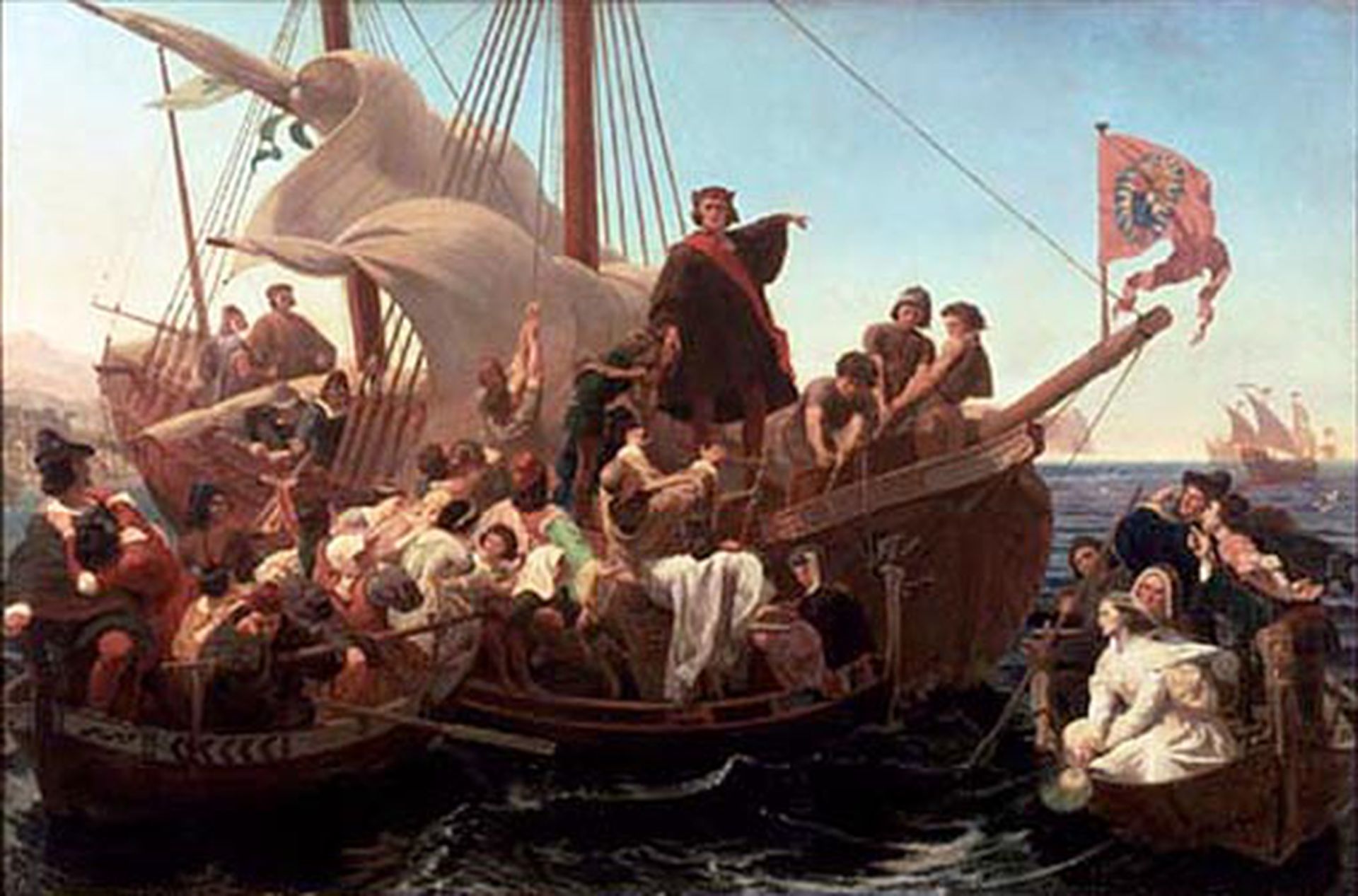 |
| Expedition of Columbus |
I had a very productive day at the library doing further research for new sources to incorporate into my topic. While spending two hours in the library searching for new biographical sources I could use to support my thesis, I not only felt like Christopher Columbus sailing around the world, I came up with the idea to include the literary movements of each author as part of my analysis. This led me to books on Modernism and the Victorian Era which characterize Adams and Carroll respectively. Here is the latest version of my thesis statement included in my introductory paragraph:
The following is a list comprising my annotated bibliography:
"Everyday, individuals all over the world are experiencing new things. These experiences shape the way these individuals think, and contribute largely to who they are. The same is especially true of writers. A writer's environment plays a major role in the perspective he takes when writing a novel. As seen in the examples of Richard Adams and Lewis Carroll, the similarity in their country of origin, family background, and social status all play a significant role in the similar themes and ideas these writers convey to their audiences, as evident throughout each of their texts."
The following is a list comprising my annotated bibliography:
Bibliographies and Poetry and Such
Working thesis: Despite the difference in age and
experience, Alice plays the role of Morrie in the lives of the creatures she
encounters in Wonderland.
 |
| A quote from Morrie's favorite poet, W.H. Auden. Creative Commons License 2.0: credit to Debra. |
Subscribe to:
Posts (Atom)