Here is my video introduction of my final paper:
I shared this video on Facebook and Google+. Enjoy!

Showing posts with label posted by Kimberlee. Show all posts
Showing posts with label posted by Kimberlee. Show all posts
Tuesday, April 22, 2014

Monday, April 21, 2014
The Journey's End
 |
| Creative Commons License 2.0 / jayneandd |
Then I looked back at the Personal Literary Narrative I'd written about Anthem, and the thing I said I loved the most about this novel was the language. And then, as I thought about it, I realized that all of the papers I've written in this class so far have had some sort of linguistic twist. Language is my thing, apparently. And since language is such an integral part of both novels anyway, it seemed like a good topic to discuss.
But even though I had a topic, I still didn't know exactly which route to take. My first idea was actually to write about how language controls thought. I circulated this vague idea around to a few of my friends, who gave me some decent feedback and suggested that I talk about how language affects identity.
Wednesday, April 2, 2014
Through the Library
Since we didn't have class today (Wednesday), I spent some time in the library looking up articles and books that might be helpful sources to use for my paper. Using various combinations of "Ayn Rand," "Anthem," "Lewis Carroll," "language," "linguistics," "thought," and "control" (some general searches, others combined more specifically), I found a few sources that I may or may not use directly in my paper, but either way could be helpful:
 |
| Major levels of linguistics / Wikipedia |
- an article about Rand's promotion of narcissism and worship of "This god, this one word: I" (which also slams Donald Trump as a politician)
- a brief abstract of a graphic adaptation of Anthem, made in response to a letter that Ayn Rand wrote to Walt Disney requesting that if Anthem were to be made into a film, she would like it to be represented with stylized drawings rather than live actors (so the graphic novel version apparently features stylized drawings)
- a book called Language and Lewis Carroll which sounds very relevant to my argument
- an article that puts Lewis Carroll's use of linguistics into the context of Victorian language theory--the idea of "autonomous language" wherein words have a life outside of the speaker, which actually sounds really interesting
- an article examining the historical origins of language and speech itself (maybe relevant?)
- a more science-y article about how automatic language processing is, focusing on neurological processes (probably not terribly relevant to my paper but still interesting)
- and another science-y article about whether or not thought is dependent on language (which actually should be very relevant to my paper)...
Monday, March 31, 2014
Coming Together
The thing I've worked on most with my paper so far is just finding key passages that demonstrate how language affects the thoughts and/or actions of the characters, and I've done a bit of research, but the thing I need to focus on most as I write my paper is cohesion. I know how to analyze specific passages to support my point, but I know that a collage of key passages doesn't mean anything if I can't draw them together in a cohesive argument that starts somewhere and leads to somewhere else in order to prove (or at least support) the point of my thesis.
I think that I have enough feedback at this point in my process to start digging into my paper, but more feedback and suggestions are always welcome. But I feel like at this point in the process, more feedback won't be helpful until I actually write more of my paper and give people something more substantial to give me feedback about. If that makes sense. So I really just need to sit down, stop procrastinating, and start writing.
 |
| Creative Commons License 2.0 / Matt Gibson |
I think that I have enough feedback at this point in my process to start digging into my paper, but more feedback and suggestions are always welcome. But I feel like at this point in the process, more feedback won't be helpful until I actually write more of my paper and give people something more substantial to give me feedback about. If that makes sense. So I really just need to sit down, stop procrastinating, and start writing.
Friday, March 28, 2014
The Mark of Good Writing
 |
| Creative Commons License 2.0 / Adam Groffman |
Wednesday, March 26, 2014
Research in Wonderland
I've started to do some research about the general topic of my thesis--language in relation to thought. Professor Burton pointed out the Sapir-Whorf hypothesis to me in a comment on a post from a little while ago, so I decided to do a bit of additional research on the theory itself. I found a few articles about the theory and its relevance today, as well as, to some extent, its use in literature, so I think that will be really helpful.
Friday, March 21, 2014
Language is Power
 |
| Creative Commons License 2.0 / Horia Varlan |
To what extent do you think that language actually controls thought? Does this bother you?
This is what my paper is about, and I want to know how relevant and interesting this subject is. I've written out an introduction and a little bit of sample analysis. It's still super rough and I haven't really revised it yet, but here's a sample of my basic ideas:
Language is the medium through which thoughts are formulated, and thought is often limited by the limitations of the language. This idea has been explored through literature throughout history; notably, George Orwell’s Nineteen Eighty-Four comes to mind, in which the Party actively eradicates all excess words to make the vocabulary of the people smaller in order to reduce the chance of “thoughtcrime” (citation needed). But before Nineteen Eighty-Four was published in the year 1949, Ayn Rand’s Anthem (published in 1938) and Lewis Carroll’s Through the Looking Glass (published in 1871) both explored the effects of language on someone’s thoughts, actions, or perception of reality. Anthem is a dystopia, with obvious social commentary about language, whereas Through the Looking Glass has a much more whimsical tone and uses language less oppressively, but despite their different genres and tones, each novel demonstrates how language can literally control people, and limitations in the language lead to limitations of thought.
Wednesday, March 19, 2014
On Feedback and Publication
 |
| Creative Commons License 2.0 / Bill Bradford |
The second peer that I connected with is my friend Ira from my Italian class, who is pursuing her master's degree in Linguistics. After talking with her briefly about my paper, she told me that she had also written a paper about the use of language in Alice and Wonderland, and so she emailed it to me. I gave her the link to the blog and she also said that she would talk to some of her own peers in her linguistics classes, some of which majored in English for their undergraduate degree, to see if they had any ideas, and that she would email me if she or they had any more suggestions. This is enormously helpful because I can connect to a broader audience of people who are also interested in language itself, and I'm excited to get more feedback.
Tuesday, March 18, 2014
Finding Similarities
 |
| Creative Commons License 3.0 / Antonio Litterio |
So then I asked myself: what does the use of language in each text have in common? It's obvious, in Anthem, that language controls thought. Equality 7-2521 speaks in a plural first-person point of view, and struggles to conceptualize things that have been omitted by the language. So my next question was whether or not language served the same function in Lewis Carroll's works.
In Anthem, the language:
- omits the idea of the individual
- oppresses the people--speaking the word "I" is punishable by death
- controls characters (prevents individuality)
In Through the Looking Glass, the language:
- adds to confusion and chaos
- creates humor (puns, etc.)
- controls characters (characters obey nursery rhymes with or without realizing it)
Here's the link to a shell of my final paper:
https://docs.google.com/document/d/1qVBPRyYmTW8EyMyAbwK87n4hWn2tjx1cAm_AxW8qCgM/edit
Friday, March 14, 2014
"What are the words which we have lost?"
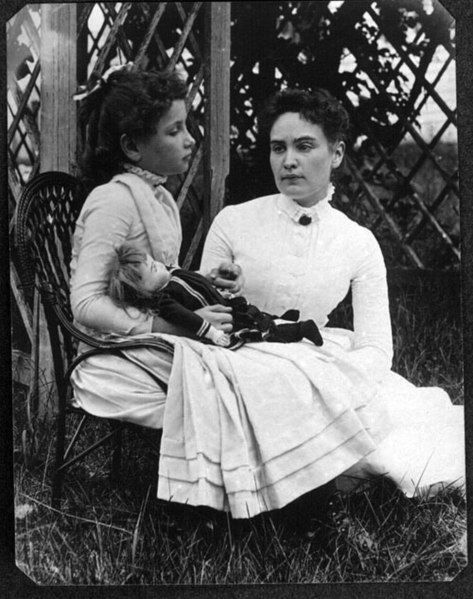 |
| Helen Keller with her tutor, Anne Sullivan, 1888 |
up without language of any kind. She behaved savagely, grunting and screaming and grabbing fistfuls of other people's food with animalistic instinct, until her tutor, Anne Sullivan, taught her to behave, but more importantly, how to use sign language. When Keller finally understood the connection between the objects and the signs for them that her teacher showed her, she had a revelation. And from there, she was able to progress and grow and become an inspiration for many.
After the film, I remember wondering how someone who is blind and deaf--someone who has never been exposed to language--would form thoughts in their mind. Would it just be a haze of fleeting instincts and flashes of tactical perception? I couldn't imagine trying to think without the essential element of language.
Thursday, March 13, 2014
The Great We (with a side of jam)
Language has always been one of the most interesting things to me about literature. It's actually really interesting to me in general, and something I've been thinking about lately is how language correlates with thought and one's perception of reality.
In Ayn Rand's Anthem, for example, everyone's thoughts appear to be controlled by their language. In part one, Equality 7-2521 states the following:
"WE ARE ONE IN ALL AND ALL IN ONE. THERE ARE NO MEN BUT ONLY THE GREAT WE, ONE, INDIVISIBLE AND FOREVER."
We repeat this to ourselves, but it helps us not. These words were cut long ago. There is green mould in the grooves of the letters and yellow streaks on the marble, which come from more years than men could count. And these words are the truth, for they are written on the Palace of the World Council, and the World Council is the body of all truth. Thus has it been ever since the Great Rebirth, and farther back than that no memory can reach.
The mantra of the Great We, that states that there is "only the great we, one, indivisible and forever" eradicates the concept of the individual. Equality 7-2521 states the mantra as "truth," and he believes it at this point in the story because this is what he has always been told. He can't even conceptualize the idea of the individual. And the reader must remember that every other character in the story is also one individual human being, yet they support this idea of the Great We with religious zeal: "There is no crime punished by death in this world, save this one crime of speaking the Unspeakable Word."
But Anthem is not the only story in which the language controls the thoughts and reality of the characters. For example, in Lewis Carroll's Through the Looking Glass, Alice experiences a linguistic impasse with the White Queen when the discuss the conditions that Alice would experience under her hire: "Two pence a week, and jam every other day."
Alice tells the Queen that she doesn't want any jam that day, and the Queen tells her that she couldn't have any jam anyway, because "It's jam every other day: to-day isn't any other day, you know." The language controls them: it will never be possible to eat jam, because it will always be today, and therefore never a jam day.
 |
| Creative Commons License 2.0 / Image by Brent Miller |
Wednesday, March 12, 2014
A (Slightly) New Direction
After class last week, I was talking with Annalee about our topic/working theses. Annalee is writing about The Count of Monte Cristo, and how existentiality and loss of identity were prevalent themes in both Count of Monte Cristo and Alice in Wonderland as a result of their respective historical contexts, which sounds really interesting. I proposed my thesis idea to her—how I wanted to talk about how language affects the characters in both Anthem and Alice—and she expressed enthusiasm in my topic as well and agreed that it would be a paper worth writing.
I received some helpful comments when I posted my “tweethis” on the blog as well. Although Sophie is discussing childhood and authority figures in As I Lay Dying, she still recognized that language affects things within her story, too. My professor provided a useful external source discussing the relationship between thought and language, and Adam suggested narrowing my thesis to focus on how the language affects the different contextual mediums (governmental opposition vs. imagination), which is also a possible angle I could take on this paper.
Then I proposed my working tweethis to my friend Alyssa, and she suggested a different direction. She asked me how language affects the story in Alice in Wonderland, and I realized that the language seems to distort reality in Wonderland more than it affects Alice’s thoughts, and that the same could be said about language distorting reality in Anthem. But then again, reality is just how we perceive things, so that ties into thought as well.
So then I went back and read a comment on a former post and saw a comment that Annalee had posted that I'd previously overlooked--a suggestion to look at the language from the lens of identity. This seems to have more relevance to both novels and I think this would be a really interesting direction for my paper.
I received some helpful comments when I posted my “tweethis” on the blog as well. Although Sophie is discussing childhood and authority figures in As I Lay Dying, she still recognized that language affects things within her story, too. My professor provided a useful external source discussing the relationship between thought and language, and Adam suggested narrowing my thesis to focus on how the language affects the different contextual mediums (governmental opposition vs. imagination), which is also a possible angle I could take on this paper.
Then I proposed my working tweethis to my friend Alyssa, and she suggested a different direction. She asked me how language affects the story in Alice in Wonderland, and I realized that the language seems to distort reality in Wonderland more than it affects Alice’s thoughts, and that the same could be said about language distorting reality in Anthem. But then again, reality is just how we perceive things, so that ties into thought as well.
So then I went back and read a comment on a former post and saw a comment that Annalee had posted that I'd previously overlooked--a suggestion to look at the language from the lens of identity. This seems to have more relevance to both novels and I think this would be a really interesting direction for my paper.
Monday, March 10, 2014
Anthem in Wonderland: A Linguistic Approach
We're writing a big paper in our writing literary criticism class, and I'm going to contrast Anthem by Ayn Rand with Through the Looking Glass and/or Alice's Adventures in Wonderland by Lewis Carroll. At first I was thinking about taking a generic approach--maybe trying to argue that Carroll's Wonderland is a dystopia, just as the world in Anthem is a dystopia, but let's be real. I love analyzing language way too much to pass up the opportunity to do so here.
So I'm thinking about writing something about how language controls thought in Anthem as well as in Carroll's works. What do you guys think?
So I'm thinking about writing something about how language controls thought in Anthem as well as in Carroll's works. What do you guys think?
Overcoming Perfectionism
Growing up, I've always been a perfectionist. I don't mind sharing work that I'm proud of--work that has been polished and finished and meticulously refined--but I've always zealously guarded my rough drafts and works in progress and other miscellaneous mistakes.
I'm particularly particular about my writing: I've been known to scrupulously readjust punctuation, change a word for a slightly different connotation, chip at my words with a scalpel until I am satisfied with every detail, before I am ready to share my work with anyone. But recently, I have begun to realize the value of sharing my unpolished work.
I have found, to the surprise of my perfectionist instincts, that people are actually quite supportive of my flaw-riddled talents and rough ideas. A few friends in particular come to mind as people from whom I can share my ideas, who provide support and help me to develop my own ideas.
The first is my friend Alyssa. By coincidence one day, we discovered that both of us were very interested in creative writing, and that both of us had a small portfolio of poetry and prose that neither of us had really shared publicly before. We read each other’s work and came to appreciate the differences in our writing styles. I’ve had the opportunity to edit some of her rough work, and I can turn to her for advice and constructive criticism, too, and she's honest with me. Good friends don't let each other write poorly.
I'm particularly particular about my writing: I've been known to scrupulously readjust punctuation, change a word for a slightly different connotation, chip at my words with a scalpel until I am satisfied with every detail, before I am ready to share my work with anyone. But recently, I have begun to realize the value of sharing my unpolished work.
I have found, to the surprise of my perfectionist instincts, that people are actually quite supportive of my flaw-riddled talents and rough ideas. A few friends in particular come to mind as people from whom I can share my ideas, who provide support and help me to develop my own ideas.
 |
| This is the first photo in existence of Alyssa and me together |
Tuesday, March 4, 2014
The Power of Words
One day during my junior year of high school, in a classroom
that always smelled like coffee and pencils on paper, each student was given a
sheet of white paper upon which various passages were printed for us to analyze.
The first two were simple, sensical, but the third caught my attention.
The
head of the Golden One bowed slowly, and they stood still before us, their arms
at their sides, the palms of their hands turned to us, as if their body were
delivered in submission to our eyes. And we could not speak.
Then
they raised their head, and they spoke simply and gently, as if they wished us
to forget some anxiety of their own.
"The
day is hot," they said, "and you have worked for many hours and you
must be weary."
"No,"
we answered.
"It
is cooler in the fields," they said, "and there is water to drink.
Are you thirsty?"
"Yes,"
we answered, "but we cannot cross the hedge."
"We
shall bring the water to you," they said.
Then
they knelt by the moat, they gathered water in their two hands, they rose and
they held the water out to our lips.
We
do not know if we drank that water. We only knew suddenly that their hands were
empty, but we were still holding our lips to their hands, and that they knew
it, but did not move.
My brow furrowed in confusion. Their two hands? Our lips? I
struggled to make sense of the passage before me, trying unsuccessfully to
determine how many characters were present in this scene.
Subscribe to:
Posts (Atom)