
Showing posts with label Build. Show all posts
Showing posts with label Build. Show all posts
Friday, March 21, 2014
To Overcome Authority
This is a pretty naked overview of my aspirations for my paper. However, during the past couple of weeks, I have fallen in love with FEEDBACK! So, if anyone is willing, take the time to read the following mini-paper, I'd love to have a conversation about the ideas I'm presenting!
Question: What is the effect of ignorant parenting on children and can they overcome it?
Depriving Childhood Through Authority
In Faulkner’s As I Lay Dying, the Bundren children are dwindling in poverty, selfishness, and animosity. However, in each child’s narration of the story, there can be found deep insight into human nature, which contains more prudence and virtue than that of their parents. Still, they are at the mercy of their father and recently deceased mother. Similarly, Lewis Carroll’s character, Alice, journeys into Wonderland and finds herself succumbing to the whims of various adults. Just as Alice is ridiculously scorned, mislead, and reprimanded by the authority figures in her journey through Wonderland, the offspring of Addie Bundren represent the precarious condition of children that do not have reliable authority figures in their lives in the novel As I Lay Dying. Lewis Carroll and William Faulkner's works identify the damage caused to children by dysfunctional family environments and autocratic adults.

Complete Chaos
 |
| Creative Commons 2.0 |
Questions: Can I compare Death from The Book Thief and the death themes in Alice and Wonderland and Through the Looking-Glass by using past representations of death? Would it work? Would it make sense? Is this even a good idea? Are there better ways to do this? Any advice or feedback would be greatly appreciated.
Perks Of A Possible Paper

Thursday, March 20, 2014
A Miniature Paper About Morrie and Alice
 |
| Here's Alice having a nice relaxing afternoon in the fields, unlike the rest of us, locked inside cramming for finals and writing papers. |
feedback, that would be really really nice.
Here's my miniature paper.
Monday, March 17, 2014
The Chicken or the Egg...
The writers of the Lost Generation suffered from the consequences of the Great War. They were troubled at the apparent lack of inherent human goodness and felt disappointed with social structures like religion and family. They often searched for meaning and identity in artificial things like sex, liquor, and adventure. These experiences most always led to a loss of innocence.
Ernest Hemingway’s novel The Sun Also Rises beautifully captures the every day struggle of a few of these people from the Lost Generation. The main character, Jake Barnes, slowly comes to terms with his loss of identity while kneeling in a Spanish church:
[…] as all the time I was kneeling with my forehead on the wood in front of me, and was thinking of myself as praying, I was a little ashamed, and I regretted that I was such a rotten Catholic, but realized there was nothing I could do about it, at least for a while and maybe never, but that anyway it was a grand religion, and I only wished I felt religious and maybe I would the next time […].
My question is this: Did the Lost Generation suffer at the hands of the changing world to which they belonged, or did their own selfish desires produce their feelings of disenfranchisement from society? Basically, are they being acted upon or are they suffering from their actions? Does their situation motivate their actions, or do their actions determine their situation?
I plan on circulating this to a classmate from a different English class and to a few of my acquaintances who are English majors in Colorado.
 |
| Hemingway and Friends (Wikipedia) |
Ernest Hemingway’s novel The Sun Also Rises beautifully captures the every day struggle of a few of these people from the Lost Generation. The main character, Jake Barnes, slowly comes to terms with his loss of identity while kneeling in a Spanish church:
[…] as all the time I was kneeling with my forehead on the wood in front of me, and was thinking of myself as praying, I was a little ashamed, and I regretted that I was such a rotten Catholic, but realized there was nothing I could do about it, at least for a while and maybe never, but that anyway it was a grand religion, and I only wished I felt religious and maybe I would the next time […].
My question is this: Did the Lost Generation suffer at the hands of the changing world to which they belonged, or did their own selfish desires produce their feelings of disenfranchisement from society? Basically, are they being acted upon or are they suffering from their actions? Does their situation motivate their actions, or do their actions determine their situation?
I plan on circulating this to a classmate from a different English class and to a few of my acquaintances who are English majors in Colorado.
 |
| Pamplona, Spain (Wikipedia) |
Sunday, March 16, 2014
To the Core
The Victorian Era and the 80's don't seem to have much in common...
Experiences, focus', and expectations for life and society may have changed, but what drives people to pick up a book seems to be timeless.
Coming of age, feminism, breaking social norms, fantasy, unknown worlds full of new rules --
these are things that bridge the centennial gap between
Though surfaces tell us that these books are different and independent;
their core reveals the a single entity
People will pick up these novels for what they are, but they will return to these novels for the journey.
The journey of the characters, the emotions, the moral and their own growth.
Friday, March 14, 2014
Why Tell Stories?
In A Little Princess, Sara Crewe is always imagining something and often tells stories about what she imagines. She even sometimes seems to see the things she imagines as being real in a way. Although many of the other students are fascinated by her stories, many people also say that this tendency is strange. My question is what exactly is the good of fictional stories? Clearly there is a good to them. They help Sara survive her hardest times, and they help real people too. There are people who would say that a belief in impossible things can even be unhealthy. So, are stories, especially the truly unrealistic ones such as Sara’s fancy of rats being people or Alice’s trip down the rabbit hole, unhealthy or do they do a lot of good? Why?
I plan to circulate this mostly through Goodreads, but I may also give Facebook a try. I also have a couple of past English teachers that it might be good to contact.
Point of View
In The Phantom Tollbooth, after taking the scenic route to Point of View, the boy Milo and his companions stop and take in the sight of the green valley stretched before them.
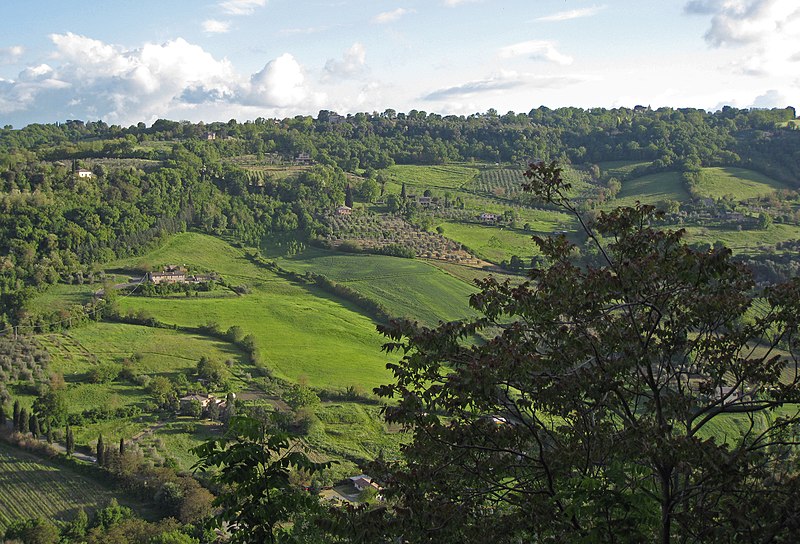 |
| Creative Commons License 3.0 Credit to Dcrjsr |
"'Isn't it beautiful?' gasped Milo.
'Oh, I don't know,' answered a strange voice. 'It's all in how you look at things'" (102).
The voice belonged to a boy named Alec Bings, who was standing three feet above the ground in midair. Alec explains that in his family, every person is born with his head exactly where it will be when he is an adult, and he grows toward the ground.
"'You certainly must be very old to have reached the ground already,' [said Alec].
'Oh no,' said Milo seriously. 'In my family we all start on the ground and grow up, and we never know how far until we actually get there.'
'What a silly system.' The boy laughed. 'Then your head keeps changing its height and you always see things in a different way? Why, when you're fifteen things won't look at all the way they did when you were ten, and at twenty everything will change again.'
'I suppose so,' replied Milo, for he had never really thought about the matter" (105).
Subscribe to:
Posts (Atom)